
LAFVIN ESP32 IoT Learning Kit,ESP32 Core Controller Board with Multifunction Sensor Blocks,RFID Sensing Module,PIR Sensor Module
ESP32 IoT Learning Kit
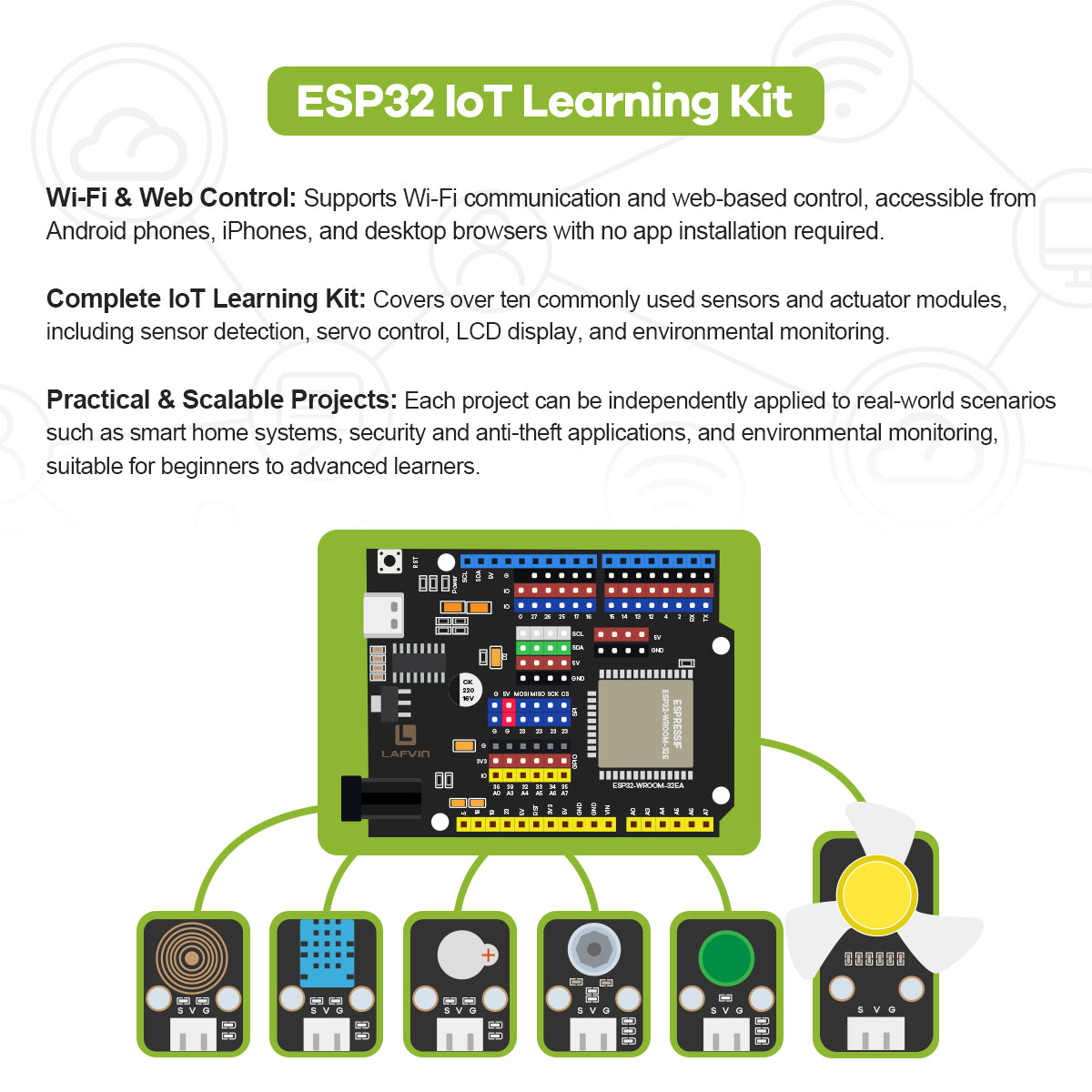
This kit uses the ESP32 as its core controller and integrates a variety of common sensors and actuator modules, resulting in a rich system with wide applicability. Its key features and advantages are as follows:
1. Multifunctional Integration
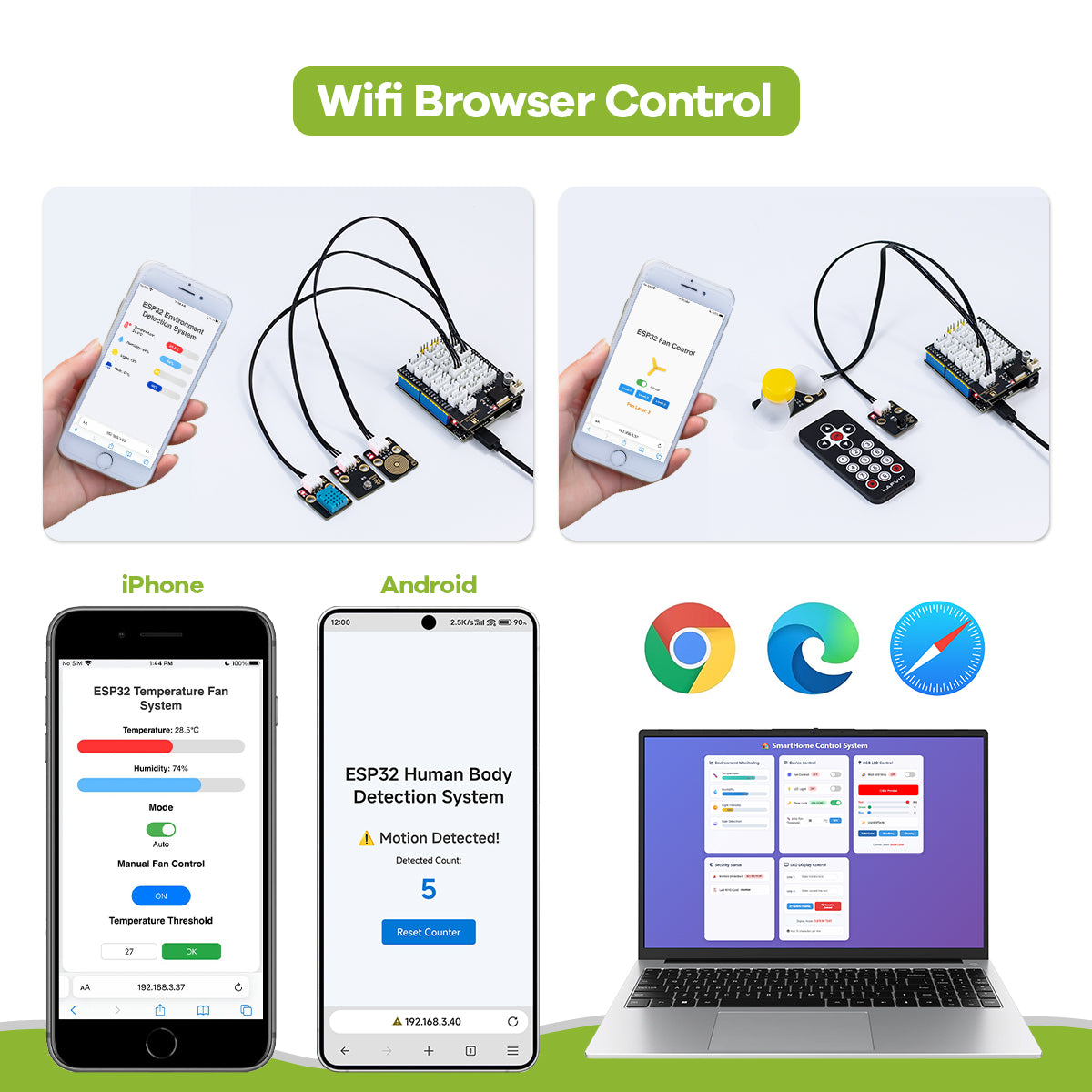
Supports Wi-Fi communication and web control for remote monitoring and interaction.
Provides sensor detection, servo control, LCD display, and environmental monitoring functions, covering the core modules of IoT applications.
Suitable for a variety of experimental scenarios, from basic learning to comprehensive applications.
2. Suitable Audience and Scenarios
Suitable for beginners of electronics and IoT for learning and practice.
Can be used for maker education in primary and secondary schools, Arduino programming teaching, and laboratory project research.
It is also suitable for smart home prototype development, helping users quickly master the core principles of intelligent control and IoT applications.
3. Hardware Design Advantages
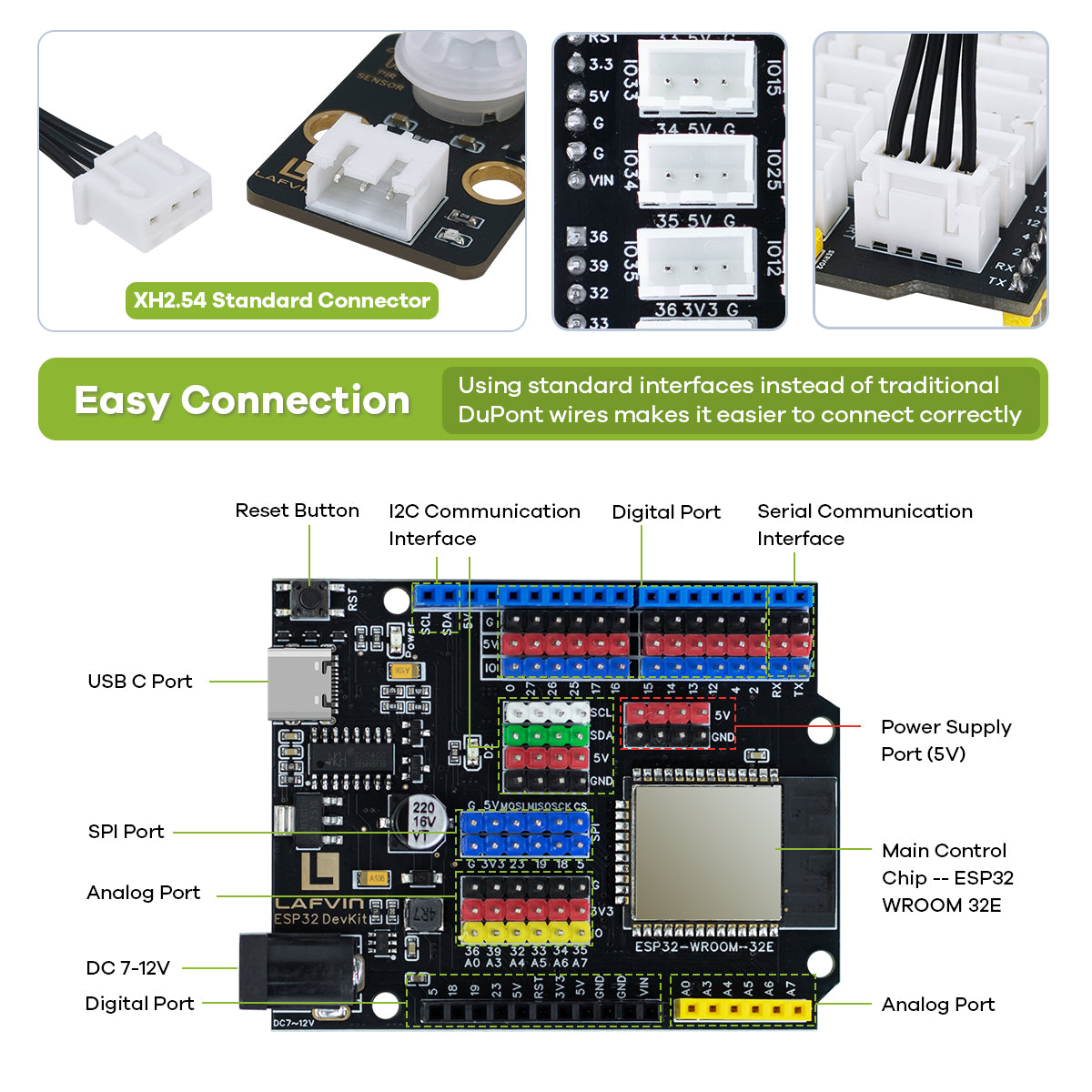
Using the ESP32 development board and dedicated expansion board design, the modules are standardized and the interfaces are unified.
All modules use the XH2.54 interface with reverse polarity protection to ensure secure connections.
All modules adopt gold deposition process, with good oxidation resistance and durability, and better electrical characteristics;
Module interconnection can be completed without a breadboard, simplifying wiring, improving experimental efficiency, and enhancing ease of use.
4. Abundant Course Resources
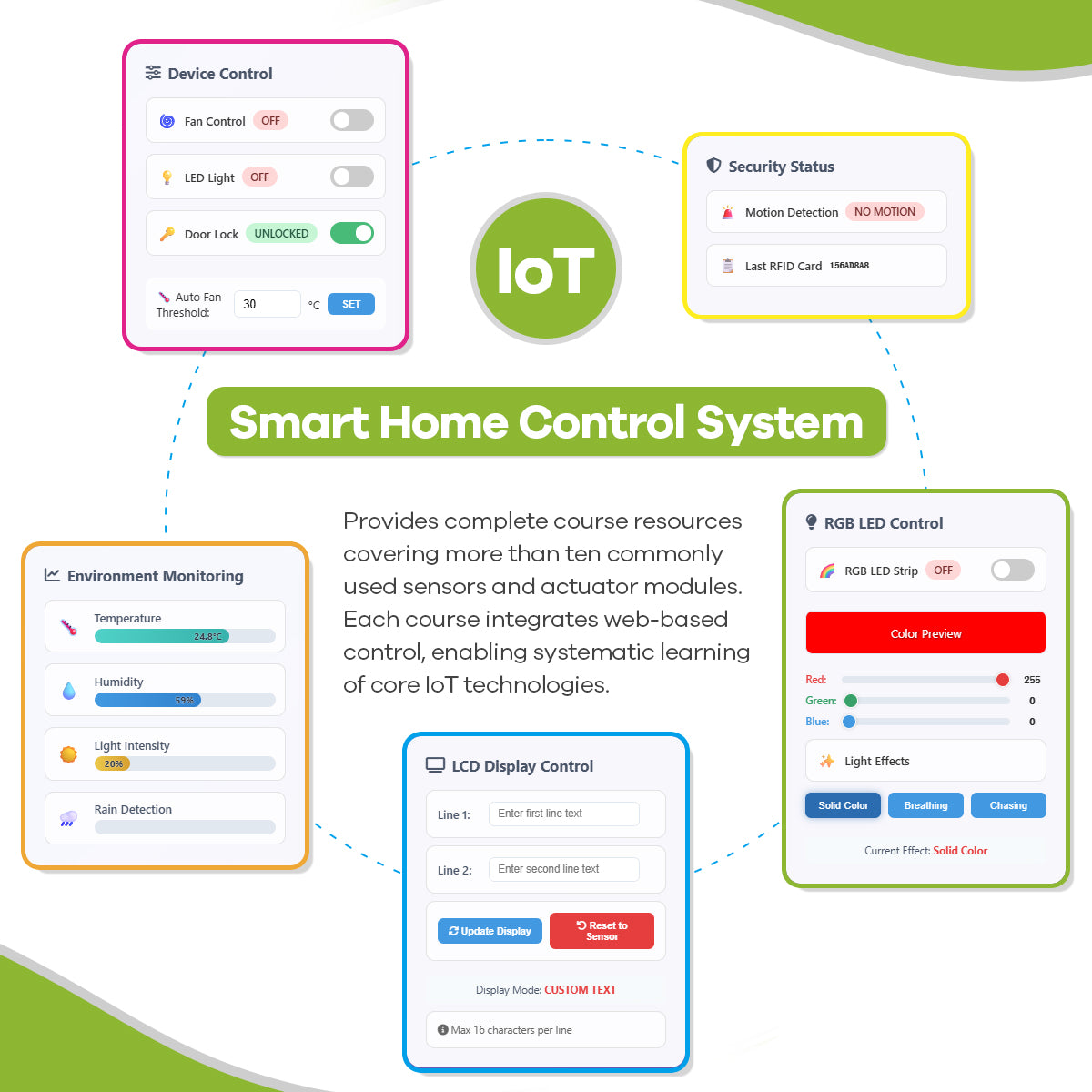
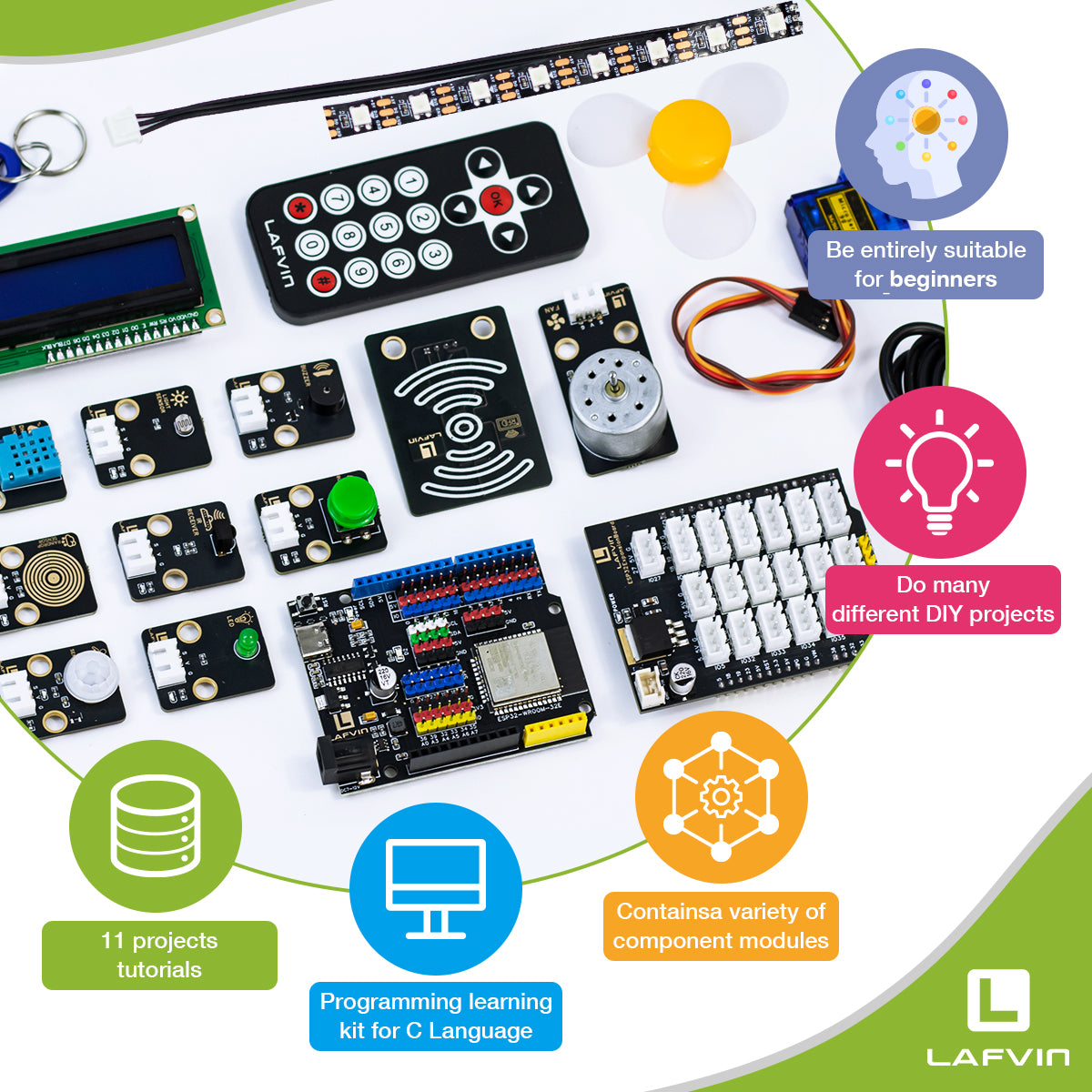
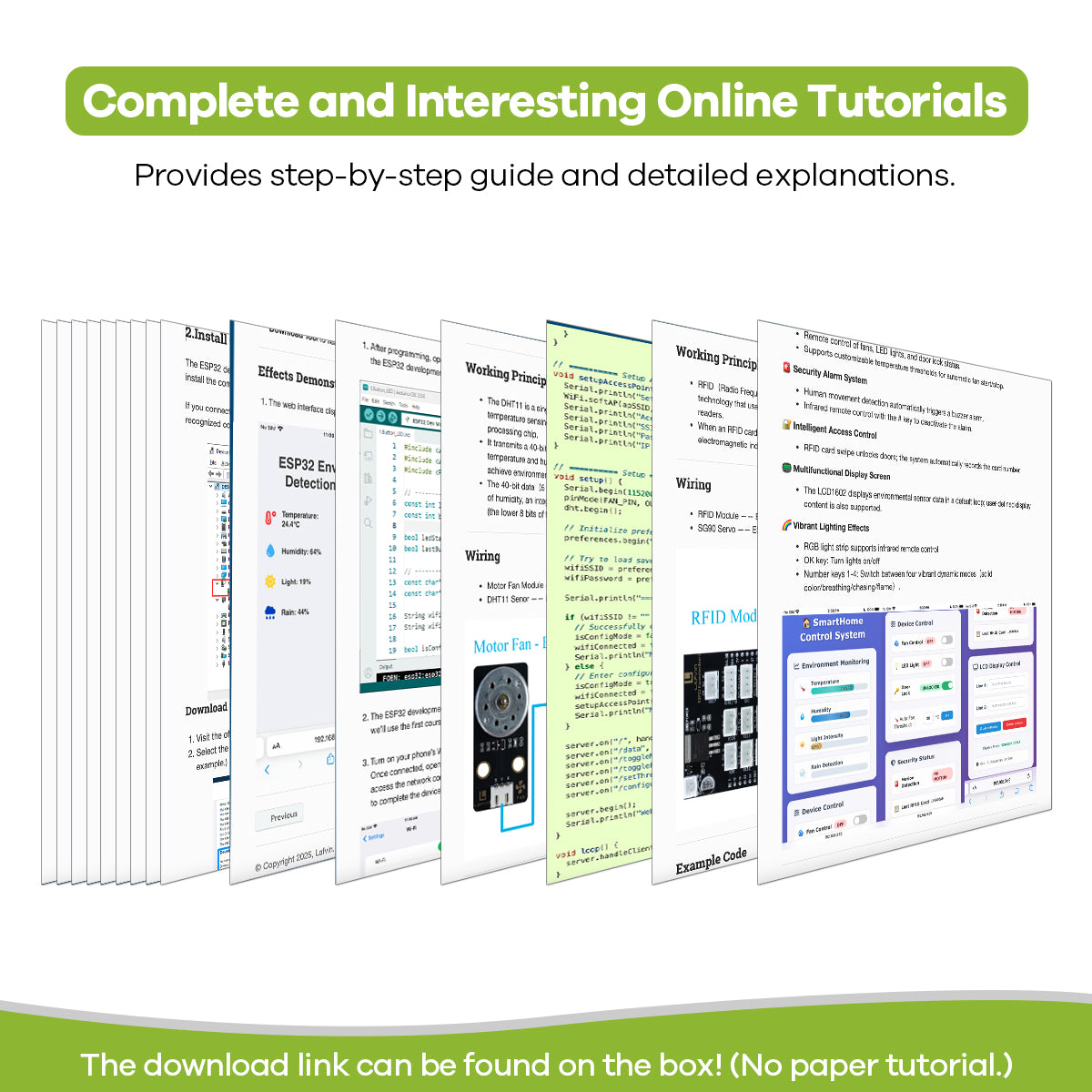
Provides comprehensive course resources covering over ten common sensors and actuator modules.
The course content progresses step-by-step, from basic introductory techniques to comprehensive applications.
Each experiment features a web control interface, making it both engaging and practical.
5. Skill Acquisition and Application
Master ESP32 programming using the Arduino IDE.
Proficient in reading digital and analog sensor data.
Understand Wi-Fi connectivity and web server design, and master methods for environmental data collection and multi-module linkage control.
Develop a deep understanding of the working principles of RFID sensing and identification.
Be able to implement real-time IoT web monitoring and remote interaction, demonstrating practical IoT system development capabilities.
Course Design:
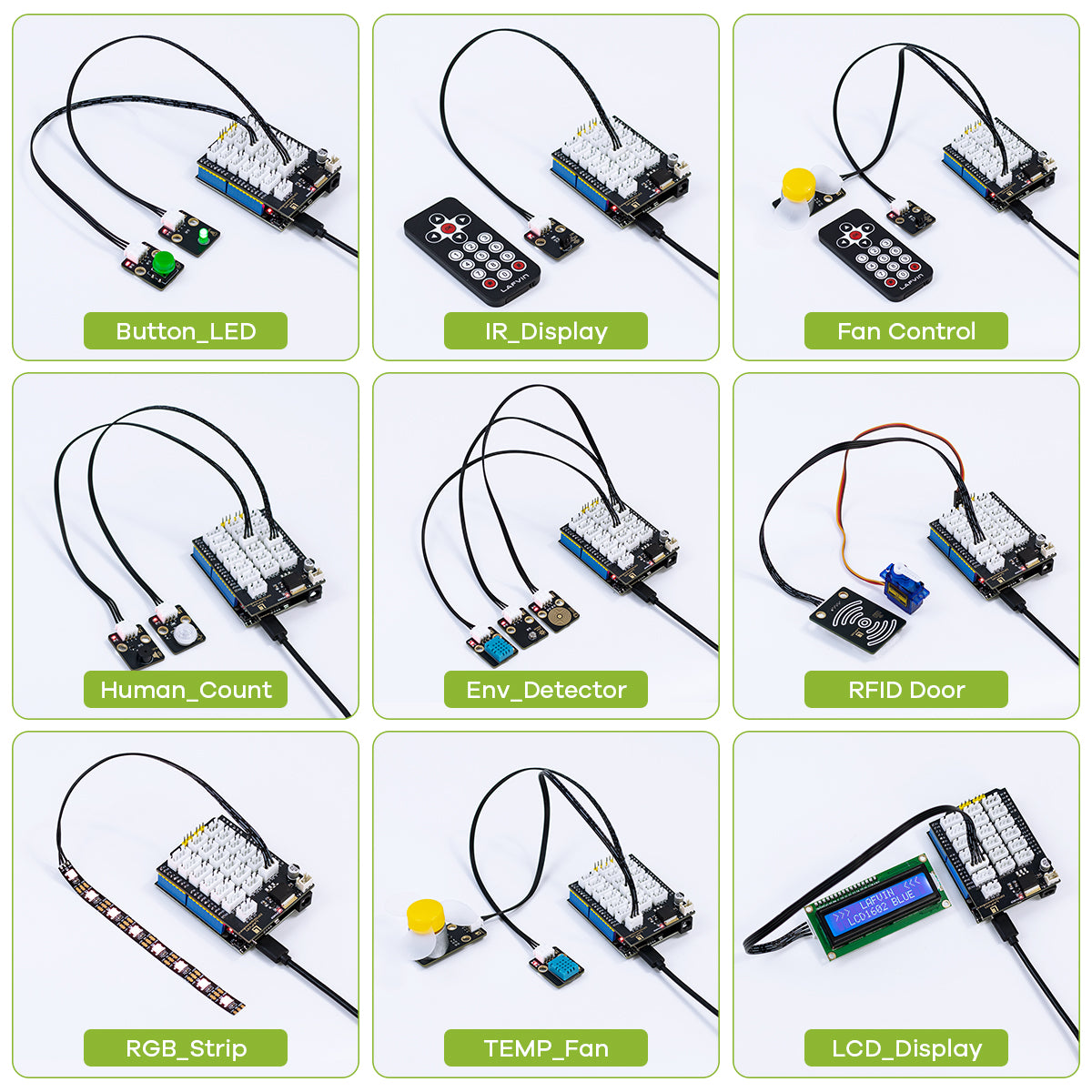
Course 1: Light Control with Button Switches - Remotely Control LED Lights with the Web
Course 2: Infrared Remote Control Button Detection and Display - Display Pressed Buttons with the Web
Course 3: Servo Rotation with a Specified Angle - Synchronously Display Servo Rotation Angle Animation with the Web
Course 4: Motor and Fan Speed Adjustment - Three-Speed Adjustment with the Web
Course 5: Temperature-Controlled Fan—Web-based control of fan on/off, threshold setting, and temperature and humidity display.
Course 6: Human Detection Alarm and Counting - Status and Counting with the Web
Course 7: Custom Content Display on the LCD1602 Screen - Text Input and Display with the Web
Course 8: RGB Light Strip Color Adjustment - Color Palette with the Web
Course 9: RFID Card Reading and Door Opening - Card Number Display and Remote Door Opening with the Web
Course 10: Environmental Monitoring and Display - Temperature, Humidity, Brightness, and Rainfall Values with the Web
Course 11: Comprehensive Course
Bill of Materials:
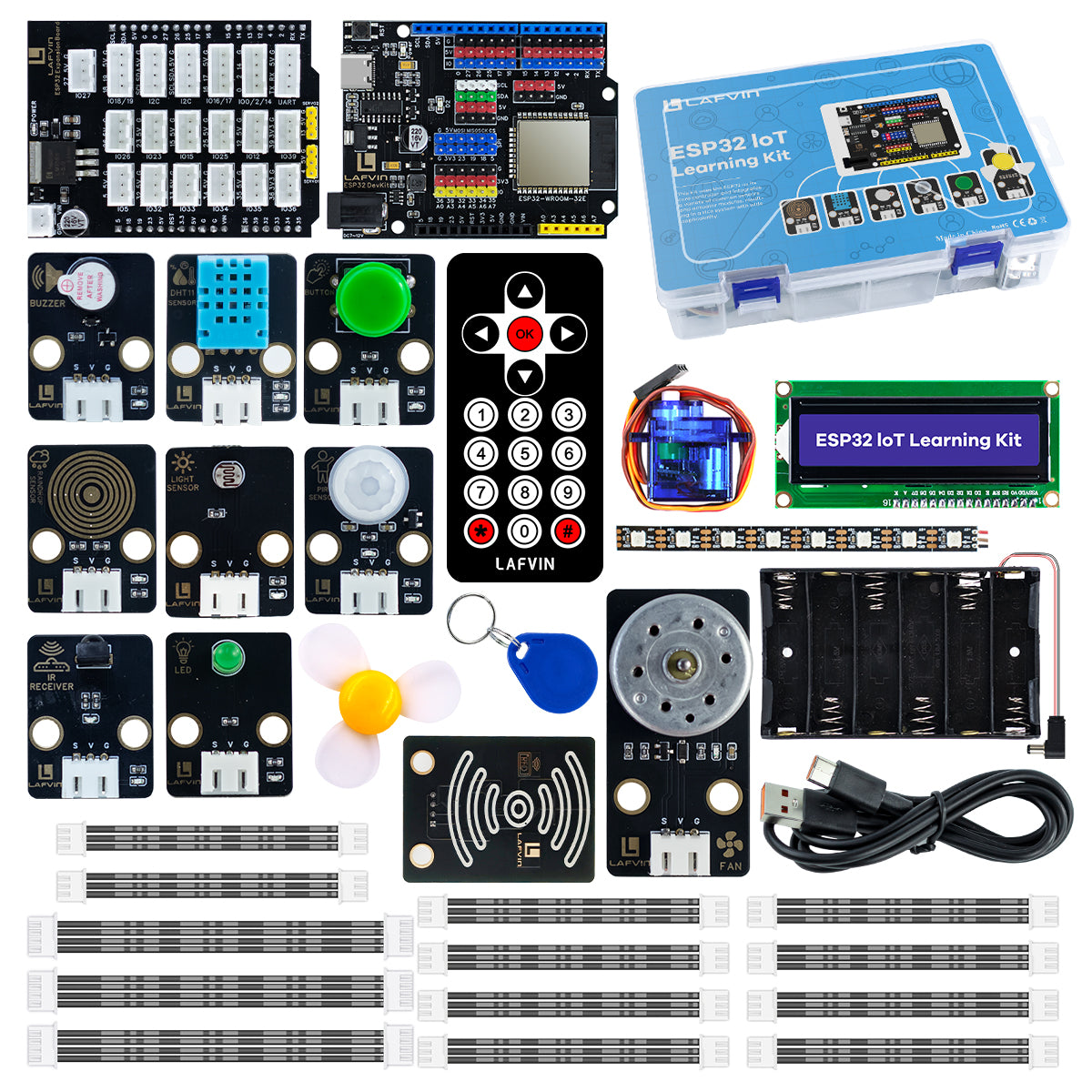
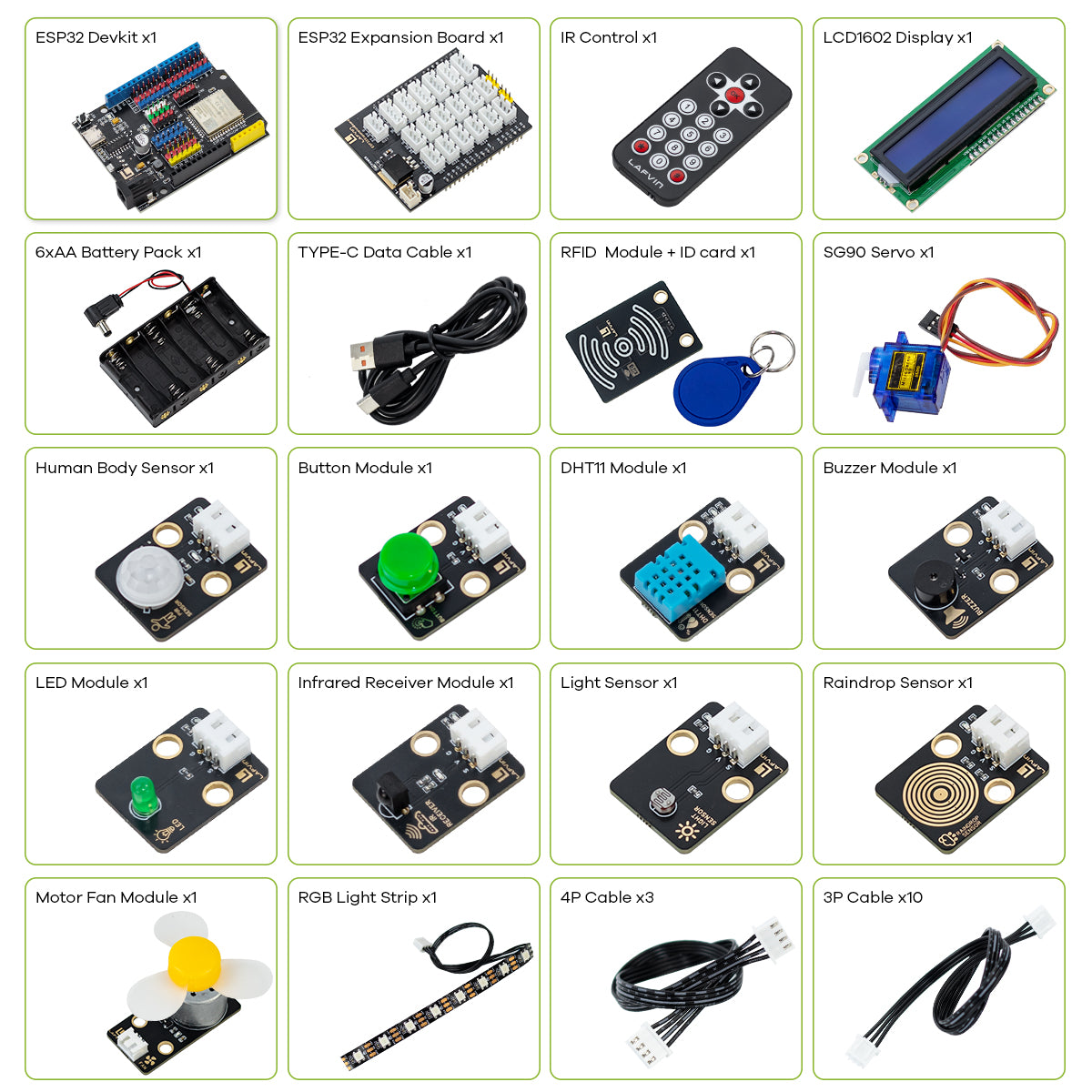
ESP32 Devkit x1
ESP32 Expansion Board x1
LED Module x1
Button Module x1
Infrared Receiver Module x1
Buzzer Module x1
Motor Fan Module x1
RFID Module + ID card x1
DHT11 Temperature and Humidity Sensor x1
Light Sensor x1
Raindrop Sensor x1
Human Body Sensor x1
RGB Light Strip x1
LCD1602 Display x1
SG90 Servo x1
Infrared remote control x1
6xAA Battery Pack x1
TYPE-C Data Cable x1
3P Cable x10
4P Cable x3
Module Introduction
ESP32 Devkit Development Board: Features a built-in dual-core Xtensa 32-bit LX6 processor with a clock speed of up to 240MHz, 448KB ROM, 520KB SRAM, and 16KB RTC SRAM, along with 4MB of external Flash memory. The board also provides up to 26 I/O ports and supports Bluetooth and Wi-Fi connectivity.
ESP32 Expansion Board: Utilizes the XH2.54 standard reverse-insertion interface, effectively preventing incorrect connections and simplifying connection steps, thereby improving development efficiency. An onboard power regulator chip ensures stable circuit operation, while the two rows of pins provide flexible wiring options.
LED Module: The LED module is an integrated high-efficiency lighting unit that can be used as an indicator light.
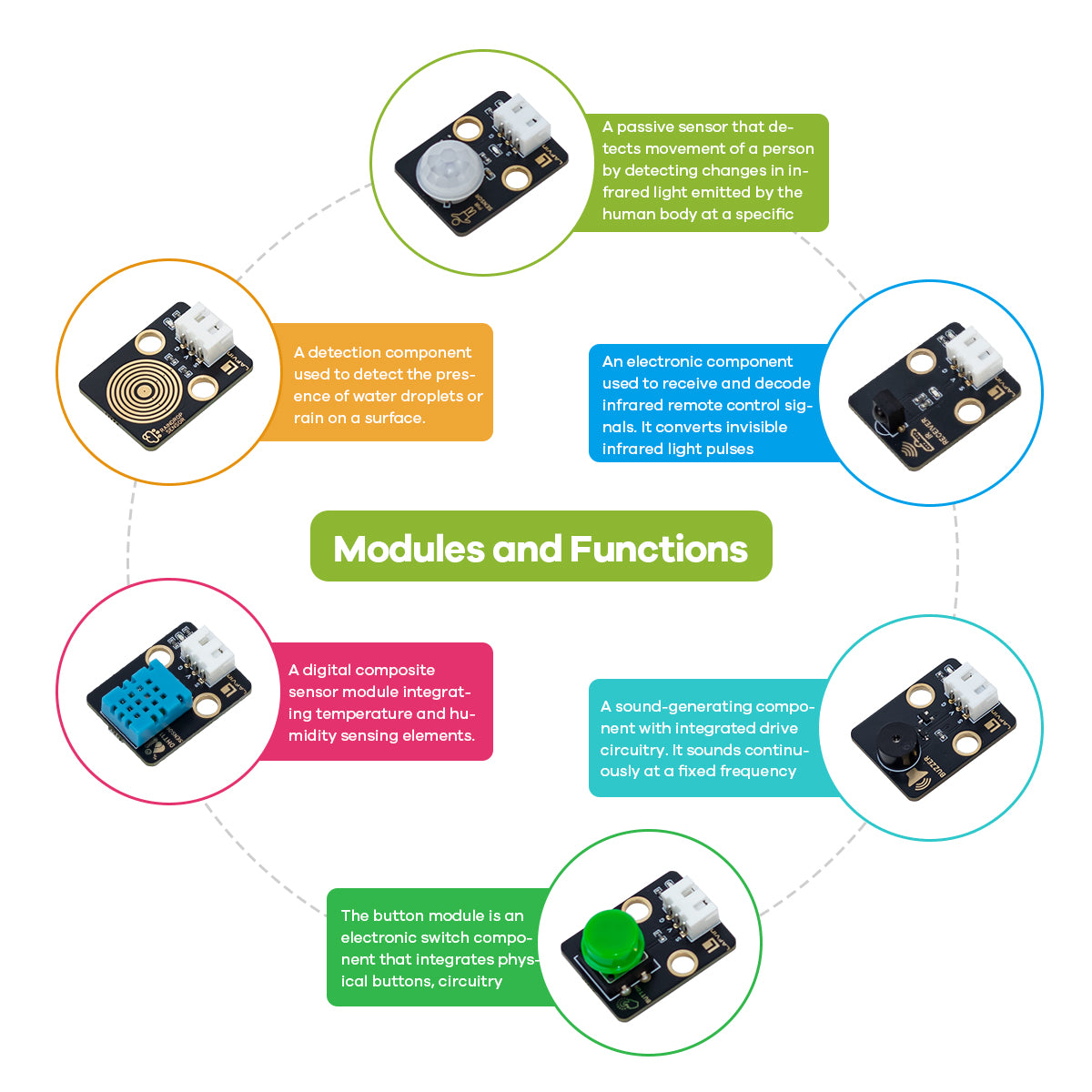
Button Module: The button module is an electronic switch component that integrates physical buttons, circuitry, and signal processing functions. Its large size design provides a more comfortable pressing feel and easier operation.
IR Receiver Module: An electronic component used to receive and decode infrared remote control signals. It converts invisible infrared light pulses into digital signals recognizable by a microcontroller.
Active Buzzer: A sound-generating component with integrated drive circuitry. It sounds continuously at a fixed frequency when powered on, typically used for alerts or alarms.
Motor Fan Module: Consists of a DC brush motor, plastic fan blades, and a motor drive circuit, integrating speed regulation and stabilization functions.
RFID Sensor Module: A device that reads and writes electronic tag data non-contactly using radio frequency signals, commonly used for identification, access control, and item tracking.
DHT11 Sensor: A digital composite sensor module integrating temperature and humidity sensing elements. It outputs calibrated digital signals via a single-bus protocol and is commonly used for basic environmental monitoring.
LIGHT Sensor: An electronic component that uses a photoresistor to sense ambient light intensity and converts it into an analog or digital signal output.
Raindrop Sensor: A detection component used to detect the presence of water droplets or rain on a surface. It outputs a signal by measuring the change in circuit impedance caused by raindrops, and is commonly used in intelligent sensing systems such as automatic window closing.
PIR Sensor: A passive sensor that detects movement of a person by detecting changes in infrared light emitted by the human body at a specific wavelength. It is commonly used in automatic lighting and security alarms.
RGB LED Strip: An intelligent LED strip module composed of 8 independently controllable RGB LED beads connected in series. The color and brightness of each LED bead can be precisely and dynamically controlled via a single-wire digital signal.
LCD1602 Screen: A commonly used character-type liquid crystal display module that can display two lines simultaneously, each line containing 16 English letters, numbers, or common symbols. It communicates with the main controller via an I2C interface.
SG90 Servo Motor: Receives pulse width modulation (PWM) signals and accurately converts the pulse width into the rotation angle of the output shaft.
Infrared Remote Control: A handheld transmitter that wirelessly sends control commands to electrical devices by emitting encoded and modulated infrared light pulses through infrared LEDs.